Day 184: stuck on you

June 5th, 2018. Bedtime.

Me: [turning over onto my right side]: Good night.

La Bonavita [putting his arm around me, which produces a slight rustling sound]: What is this?

Me: [mumbling sleepily]: What’s what?

La Bonavita [rummaging under my shirt]: there’s some paper or something stuck to you.

Me [squirming]: no there’s not! Stop it, I’m trying to go to sleep!

[sound of band-aid being ripped off]

Me [sitting up angrily]: What are you doing? What is that?

La Bonavita [peering at a small piece of paper in the dark]: Why did you have your I voted sticker stuck to your boob?

Me [relaxing and turning back over]: Oh, I think I just put my shirt on inside out, it must have gotten stuck to me.

La Bonavita [perplexed]: Yeah, but didn’t you feel it on your skin? How could you fall asleep with that sticker stuck on you like that?

Me [sleepily]: I don’t know, it wasn’t bothering me.

La Bonavita [muttering]: You are just all mind, that’s why. You have no sensation in your body.

Me [smugly]: No, it’s actually the opposite: I’m very sensuous and a true patriot. So I need skin-to-skin contact with my I voted sticker.

La Bonavita: Uh-huh.

I fall asleep to the soothing sounds of La Bonavita harrumphing to himself.

Standard

Day 182: Damn girl

Under the definition for allured, adj., the OED cites the following example:

thurlow

I decided to look up the passage mostly because I wanted to know who it was, exactly, whose looks had trapped the wary Tritons and whose voices had drawn allured dolphins from their native depths. I suspected it was the Sirens, but then, perhaps it was some other kind of watery nymph—nereids, perhaps, or just some common or garden mermaids.

You’ll notice that I assumed the alluring object would turn out to be feminine, which is, I think, a rational assumption given the culture we live in. An aquatic creature whose physical features entice others is generally characterized as feminine. A notable recent exception is the creature in The Shape of Water; indeed, the film draws attention to the exceptionality of this gendering in the very first line of dialogue that is spoken to Elisa, the film’s protagonist: “Did the sirens wake you up?”

The sirens of myth are more famous, of course, for lulling their listeners (“go to sleep you little baby,” they croon in O Brother, Where Art Thou?) into what is inevitably, a false sense of security.

For this is generally the other prevailing feature of an alluring aquatic creature: she is dangerous.

Sometimes it takes a child to spell this out for you.

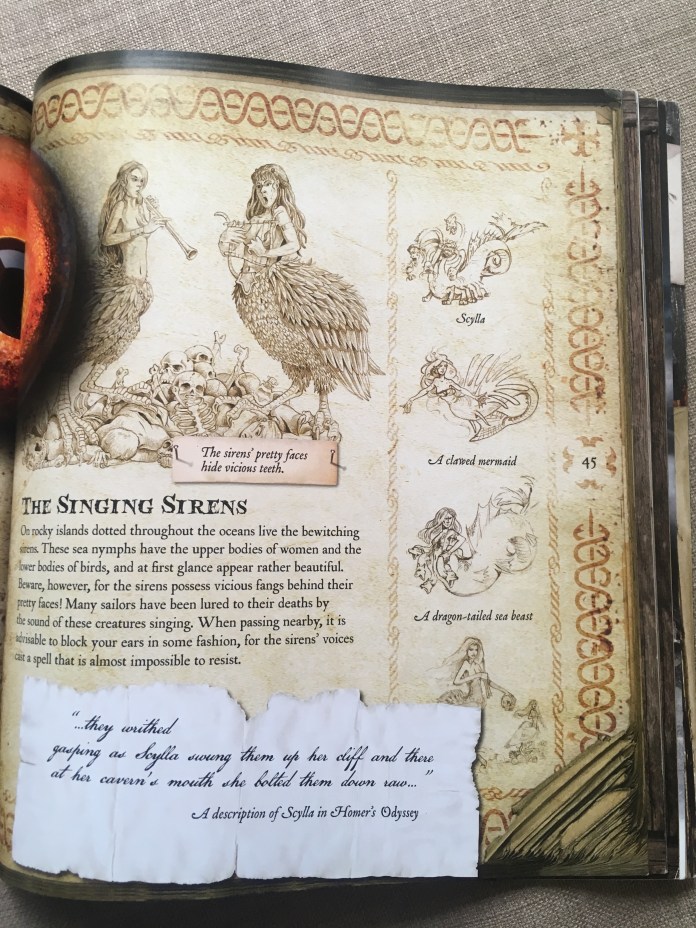
Maybe six months ago, the younger was lying on her bed flipping through a book she loves called Beastworld: Terrifying Monsters and Mythical Beasts. Every page is devoted to a different mythological monster—so there is one page devoted to the yeti, another to the werewolf, another to vampires, and so on.

Suddenly she exclaimed, “Oh, this is the page of women who tempt men to their death!”

“Wait, it’s the what page?” I asked.

“They tempt men with their beauty and then they kill them,” she explained matter-of-factly.

When I looked at the page I found that it had a picture of the sirens, with whom so far as I knew, the younger was not previously acquainted.
sirens page

Since this was before the younger could really read (her reading skills have accelerated from zero to sixty in the last six months), I was curious to know how she had arrived at the conclusion that this was the page of women who tempt men with their beauty and then kill them. I mean, yes, the pile of skulls is a clue; but the depicted Sirens also don’t look terribly alluring.

So I asked her.

Pirates of the Caribbean,” she answered immediately.

There aren’t any sirens in Pirates of the Carribean, but there are mermaids who feature prominently in the second movie, On Stranger Tides. 

Now, these are no little mermaids. No, they are all grown up, and I remembered, then, that when we had watched the one featuring these voluptuous killer mermaids, the younger had asked curiously, and quite reasonably, “why are mermaids always sexy AND dangerous?”

Why indeed.

The association is built-in to the very concept of what it means to be alluring. The word allure comes from aleurir meaning to lure a hawk—not with food, but with a contraption made of feathers tied to a cord—that mimics their favorite quarry.

Something that allures, in other words, is both attractive and deceptive. It allows the perceiver to believe itself the pursuer in order to entrap it.

But I’ve gotten distracted, just like a dolphin with ADHD. Killer mermaids will do that.

What I was trying to tell you is that I wanted to look up the lines from the poem called “Moonlight,” so that I could confirm exactly who it was whose looks trapped the Tritons and whose voices allured those distractible dolphins, and whether it was in fact the female of the species.

But here’s the thing. I couldn’t find the lines. I could find the poem—the very edition that seemed to be cited, from 1814, but it did not contain those lines. See for yourself.

I looked hard, and eventually enlisted others (Dr. Lake, that wrangler of Tupperware drawers, literal and figurative, and La Bonavita, he who had previously solved, seemingly effortlessly, the mystery of “lights for cats!”) in the search. We combed the internet so thoroughly that I was forced to admit defeat and, in desperation, emailed one of the etymologists at the OED, whose email address, yes, I happened to have on hand for lexicographical emergencies such as this and, no, I don’t think that’s odd.

When, after a few days, I still had not received a reply, part of me became fully convinced that the reason for the delay was that the entire staff of the OED was on emergency duty working around the clock to hastily cobble together a James-Macpherson-style-fake poem from which these lines could plausibly have come, because they knew that I had caught them red-handed and that these lines did not exist anywhere except for in this entry in the OED.

Because the more I thought about it, the fishier those lines seemed.

  1. Would the Tritons really have been trapped by the Sirens’ or mermaids’ or some other water nymphs’ looks? Wouldn’t the Tritons be wise to them? Aren’t they basically all related? (Although, in that case, perhaps it is an all-the-more-potent allure for being slightly transgressive, like being attracted to your hot cousin, so … never mind.)
  2. Dolphins are also canny, as we already know. Surely they wouldn’t be allured out of their depths by singing. And can dolphins even hear underwater? Thurlow’s lines clearly imply that the dolphins were underwater when they (supposedly) heard the singing, rather than, for example, poking their noses out adorably and listening from above the surface. No, the dolphins were clearly fully underwater because the voices allured them from their native depths. But is it even physically possible for a dolphin (or any other creature, for that matter) underwater to hear a song being sung, presumably, above the water, since sirens and mermaids are generally depicted singing while perched elegantly on uncomfortable looking rocks?

For help I turned one again to my number one source for aquatic questions by virtue of her name, Dr. Lake, who drew my attention to several interesting articles in the proceedings of the Royal Society.

Reader, the articles showed that, at least in the eighteenth century, I would not have been alone in pondering these questions.

In 1748, Mr. William Arderon committed several thoughts to print “concerning the hearing of fish,” (in which category he includes dolphins—he’s from the eighteenth century, cut him some slack!). After performing several frankly dubious sounding “experiments” including one in which he made people strip off and go under water and try to hear what he was saying, he arrives at the conclusion that fish, including dolphins, can not hear under water.

naked experiment

Other sources, however, indignantly refuted this thesis, noting the weakness of some of the evidence upon which fishes’ presumed deafness and muteness was said to rest:

mute as a fish copy

This source also contests the hypothesis that the medium of water is incapable of transmitting sound and argues, on the contrary, that if fish are unable to hear, it is due to a lack of ears, and through no deficiency of the watery medium.

Royal Society 2 conclusion

Still other accounts lent credence to my suspicion that it’s dolphins who are likely to be the perpetrators and not the victims of such sonorous manipulations: “They will leave three Days out of the Water, during which time they sigh in so mournful a manner as to affect those with Concern, who are not used to hearing them.”

affect those with concern

But other reports appeared to corroborate the poem’s implication that dolphins are suckers for a haunting melody:

lute

And then here was Buffon, who likewise supports the view that dolphins are easily lured: “their too eager pursuit after prey occasionally, however, exposes them to danger, as they will sometimes follow the object of their pursuit even into the nets of the fishermen.”

By the time I had waded deep into these murky depths and finally resurfaced, I discovered the lexicographer at the OED had written me back with a definitive source for the quotation. I have to admit that my pleasure at discovering the quote’s source was almost canceled out by the disappointment of being divested of my fond daydream that the OED‘s crack team of lexicographers had been burning the midnight oil concocting a plausibly nineteenth-century poem.

The lines, it turns out, are from a poem called “Angelica; or the Rape of Proteus” published in a different 1814 collection titled Moonlight. Moreover, the lines are taken from a stanza that Thurlow had rewritten, so they are especially obscure. (The whole poem as well as the re-written stanzas are available on the database Literature Online. I haven’t read the whole poem, and don’t have much interest in doing so; Thurlow describes the poem as “carried on from the Tempest of Shak-speare,” (it was crying out for a sequel!), “only, the name of Miranda is changed into Angelica,” just to keep things interesting. The plot involves Proteus trying to rape Angelica (i.e. Miranda) and eventually being foiled by Neptune and Amphitrite.)

Maddeningly, the discovery of the source didn’t resolve the mystery. Here are the lines that immediately precede and follow the lines cited in the OED‘s entry:

Yet have I seen the wonders of our globe,
Oft passing to their hymeneal beds,
When Summer smooth’d the seas; whose looks have trapt
The wary Tritons, and their voices drawn
Th’ allured dolphins from their native depths.
And yet I lov’d not; lov’d not, ’till I saw
Angelica, thou merely mortal foe,
Yet more, than thrice celestial to my soul!

The final lines are clear enough, but the first three are not particularly helpful in clarifying who it is, exactly, whose looks have trapped the wary Tritons and whose voices have drawn the allured dolphins. After puzzling over the lines for some time, I’ve come to the conclusion that the sentiment being expressed is the nineteenth-century equivalent of this:

I’ve been around the world
Seen a million honeys
Really special girls
Gave all my time and money
But, there’s something ’bout ya
Something that’s kinda funny
It’s what you do to me, aw

(From “Damn Girl” by our very own twenty-first-century Edward Thurlow, Justin Timberlake). In which case, it’s no special siren or mermaid who traps those Tritons and allures those dolphins. No, it’s all women, everywhere.

Damn.


Standard

Day 181: on gambolling

Scene: Friday evening, after dinner.

Younger: Mom, can I go play with the basketball outside with Olivia?

Me: Yes. [pause] BUT … if the ball goes into the street, what are you going to do?

Younger: [rolling eyes] I’m going to come in and ask you to help get it.

Me: That’s right, you’re going to come in and get one of us, and we will help you get it.

La Bonavita: Because otherwise you might be smushed by a car.

Elder: Or trampled by elephants.

Younger: Or crushed by pirate ships falling out of the sky.

[pause]

Elder: Uh, that’s not a thing.

Younger: [stubbornly, suddenly on verge of tears] it is a thing.

falling ship

From Baron Munchausen’s Narrative of His Marvellous Travels (1786)

As Baron Munchausen well knew, ships that rise and fall through the skies are actually a thing, and, generally speaking, you are far better off getting on top of them. Loiter underneath them, and you’ll be crushed. Hop aboard one, and you could well get stuck up a tree. And that’s just terribly awkward.

stuck in a tree

From Baron Munchausen’s Narrative of His Marvellous Travels (1786)

Crystal B. Lake and I concur with the Baron. You need to get out from under and otherwise extricate yourself from any looming ships. If you would like to read our recommendations for how to wriggle out from under the weight of the soul-crushing pirate ship of modernity, I suggest you read this, stat.

Or, you know, you can take your chances and possibly be crushed by pirate ships falling out of the sky.

It’s your call, of course, but, inveterate Humeian that I am (and bon anniversaire, by the way, le bon David!), I’d say don’t gamble on it.

Instead: gambol on over here, and find out why we’d rather be rambling.

Standard

Day 180: the new nubbin

“Mom, do we have any baguette?”

I squint at the plastic wrapper that once contained a baguette, and which now lies limply on the kitchen counter like a snake’s shed skin.

I wrinkle my nose as I pick the bag up gingerly and peer inside.

“There’re just these two little nubbins, and they are rock hard.”

With just two heels of bread swaddled in its flimsy coils, it is hard to tell which is the wrapper’s open end. As I attempt to wrest the stale ends from their casing, they fall out the open end onto the floor.

“Also, they’ve been on the floor,” I add.

“So,” I continue, to sum up, “they are not only stale little nubbins, they are also stale little nubbins that have been on the floor.”

“I’ll take them,” the younger says.

I shrug and hand them over.

“Floor nubbin!” trills the elder, in his best ad jingle voice. “The new nubbin.”

“Now with extra floor!” I add.


Standard

Day 179: smash the penguinarchy

“A. Room. Of. One’s? Own,”* the younger read haltingly.

“A room of one’s own,” she repeated.

“Yes, that’s right!” I said.

“But what does that mean?” she asked. “‘One’s own.’ Is that like at Dad’s house?”

It took me a second to reply because I instinctively bristled at the idea that “a room of one’s own” existed “at Dad’s house” but not at my house (I’m a Girtonion, for goodness’ sake! Woolf gave the lectures on which that essay is based at Girton!); but then I got it: of course, at their Dad’s house the children each have their own room; at my house they share one.

“Well …. yes,” I acknowledged, sheepishly. “Yes, like at Dad’s house. It means having your own room.”

“But why does it say that?”

“Well, it’s the title of a book. All these mugs, the words they have on them are book titles … and the mug is designed to look like the book cover. They are all books published by a company called “Penguin Books” and that’s why there’s this little penguin at the bottom.”

“I think we have some books at school with that penguin.”

“Yes, you probably do … and I have loads of Penguin books.”

“Why is it called ‘Penguin Books’?”

“Well … I don’t know, actually. I suppose whoever started the company liked penguins? Or …. maybe—but this seems unlikely—maybe the company was started by someone whose name was penguin? Mr or Mrs Penguin?”

“Or maybe …..” the younger said, in a mysterious tone.

“Maybe what?”

“Maybe it was started by a penguin.”

“You know, I honestly never considered that possibility until this very moment,” I say quite truthfully.

“Penguins are very intelligent,” she says authoritatively.

We have been watching a lot of Planet Earth recently.

“Are they?” I say.

“Yes,” she says. “But not as intelligent as dolphins.”

“Huh,” I say. “So it would be more likely to have been started by a dolphin.”

“A dolphin pretending to be a penguin?” she suggests, scrunching up her face the way she does when she’s really puzzling something out.

“Well, it’s a possibility,” I say, feeling that we are on the brink of unraveling a massive, decades-long, inter-species publishing conspiracy.

penguin

* Helen, I wrote this post several months ago and totally forgot about it; your mentioning A Room of One’s Own the other night reminded me of it, so I went rooting around in my giant Tupperware drawer of unposted blogs, and eventually found it at the bottom of the drawer … xoxo

Standard

Day 178: contraddiction

Scene: we start off on our walk to school, and, as we do, the sun breaks through the clouds illuminating the sidewalks, which are slick and puddle-filled after an early morning rain shower.

Me: Ooh, it smells good after it rains.

A: It doesn’t smell good. It smells like dirt.

Me: I like the smell of wet dirt.

A: I don’t.

[A minute of silence follows]

Me: Look, the sun’s come out! I think that’s the last of the rain today!

A: [rolling her eyes] You don’t know that.

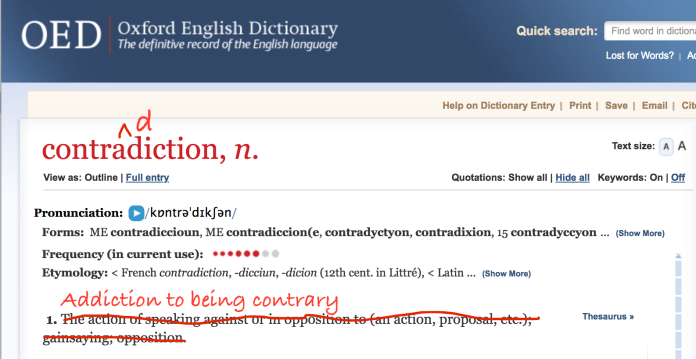
Me: [exasperated] I know I don’t know that. I’m just saying that’s what I think. [pause] I think your favorite thing is to contradict me.

A: What does “contradict” mean?

Me: It means say the opposite of what I say.

A: It means say the same.

Me: [like the sap I am]: no, it means say the opposite.

A: It means say the same.

Me: you’re contradicting me right now.

A: [triumphantly] I am NOT contradicting you right now.

contraddiction

Standard

Day 177: on being enpeached

“What does ‘impeached’ mean, literally?” wonders La Bonavita aloud. “It sounds like what happened to James in the book,” he adds.

I think about this.

“No,” I say slowly, “no, James wasn’t impeached. He was enpeached. Because the –im prefix is a negation, like impolite, but the en prefix, is, like, being in something, like enfolded, or engulfed. Right?”

La Bonavita looks unconvinced.

I continue, “So, being enpeached is much, much better than being impeached.”

“In fact,” I say, warming to my theme, “you could even say they’re opposites. Because being impeached is being, like, slapped in the face, whereas being enpeached is … well, I mean obviously I don’t actually know,” I admit, sheepishly, “but from the book it sounds, you know, pretty amazing.”

enpeached

Illustration by Nancy Ekholm Burkert from the first edition of Roald Dahl’s James and the Giant Peach (1961)


Standard

Day 176: believe in the wonder

I thought I had a psychotic break this morning.

Often, when it’s not one of my days with the kids, I will bolt out the door at the time when He-Who-Must-Be-Preserved usually walks the younger to school, so I can give her a hug on the way.

This morning I was a little late, and they had already passed by my front door, so I called her name and then ran, in my socked feet, along the sidewalk and through the dewy grass, my arms folded tight across my chest because I didn’t have a bra on under my T-shirt.

I felt slightly conspicuous, dodging the other families in my strange cross-armed run, like a particularly standoffish jogger.

The two of them stood, a little awkwardly, waiting for me to catch up. When I finally caught up to them, breathless and wet-footed, and knelt to hug her, I found that the face I nuzzled against was encased with a silky fringe: a beard.

“Awesome!” I exclaimed.

“Err, thanks,” she mumbled, sheepishly.

As I walked back home, arms still crossed, I looked to see if I saw any bearded or otherwise unusually adorned children en route to school—but no.

So I texted He-Who-Must-Be-Preserved when I got home.

“What’s the story with the fake beard?!”

His answer genuinely shocked me.

“What fake beard??”

I started and texted back, “She was wearing a beard! Am I going insane?”

I replayed the scene in my mind. I was running in my socks through the wet grass. I was wearing the black leggings and grey T-shirt I slept in last night—the T-shirt Brandy gave me that says “BELIEVE IN THE WONDER” on it. My arms were crossed over my chest, though, as if striking out those lines. The sun was shining. People were staring as I ran. I bent down to embrace my bearded child.

It did have the quality of dream.

Was it not a beard?

Had I not run through the wet grass?

But my wet socks were lying on the floor where I had discarded them!

I texted him again.

“What was that furry thing around her face?”

text 1

Was it some kind leonine halo? Some kind of ruff or fur collar? The prospect of my daughter wearing a fur collar, honestly, seemed much more implausible than the idea that she would be wearing a fake beard.

But I couldn’t rule out the leonine halo. For it seemed that I had indeed hallucinated that soft fringe. Was it possible that hair falls into that category of objects that Elaine Scarry, in Dreaming By the Book, says lends itself to the imagination—a category that includes objects like shadows and gauzy curtains?

Today, it was a bearded child; tomorrow might it be a shadow cat? Or perhaps an imaginary mosquito net canopying my bed?

So this is what madness feels like, I thought: the same as reality, but more interesting.

I remembered a quote from Winnicott. “We are poor indeed if we are only sane.” If my insanity consisted only in bestowing soft fringes upon the hairless—a beard here, a mustache there; perhaps a luxuriant tassel once in a while—perhaps it needn’t be the end of the world: I’d just be another, slightly downy, shade in the neurodiverse rainbow.

Then He-Who-Must-Be-Preserved texted back.

text 2

Later he told me that her first words upon waking up this morning were, “it’s beard day!”

Later still, when I picked her up from school, I heard the full story from the (still) bearded lady’s mouth.

And later still she asked, “Mom? I need to get something from Dad’s house before school tomorrow.”

“What is it?” I asked.

“My mustache,” she said.

Before bed, she wondered sleepily if we might make a pair of wings like Maleficent’s out of wire, paper, and feathers.

Bearded one day, mustachioed the next, bewinged tomorrow? Why not?

Believe in the wonder.

believe in the wonder

Standard

Day 175: lost and found

It was in the wake of being felled, once more, by the bottomless pit that is—or rather, was—my drawer of mismatched Tupperware, that I first suspected that Crystal Lake and I might be a good team.

Until two weeks ago, my habitual dealings with this drawer were as follows.

  1. Rummage uselessly through the wreckage of mismatched containers and lids with increasing despair and crescendoing cursing.
  2. Smush contents of drawer down sufficiently to slam drawer shut—in manner of zipping up overstuffed suitcase, or gates of hell, or extremely tight jeans; retreat to sofa, and think malevolent thoughts about said drawer and its contents.
  3. Channel my despair into writing a sad little quip about my Tupperware drawer. To wit, “Dropped a tiny tablet of Adderall into the drawer of mismatched Tupperware this morning. Knew instantly it was lost forever, like a mortal soul in Hades.”
  4. Repeat.

Enter Crystal Lake, who broke the cycle with the following text:

a lof of thoughts

Reader, she had not only thoughts, but also a list of actionable items replete with links. All I had to do was click.

Sistema

glass containers


two centslike I said

Later, after my new containers had arrived from Amazon and La Bonavita had, in a truly saintly act, discarded all the old Tupperware and replaced them with my new food storage “schema,” I reflected on what had transpired.

My four-step plan yielded a measly line of run-of-the-mill snark and maintained a cycle of chronic food storage dysfunction; Crystal’s four-step plan implemented a complete Tupperware drawer makeover.

With my talent for losing things and procrastination and her talent for … everything else, oh, the things we could do, I thought.

All of which brings me to our joint venture: The Rambling (at the-rambling.com and on Twitter @RamblingC18). The Rambling aspires to do two things: 1) to serve as a hub for collegial, collaborative reading, writing, and thinking about the long, deep, wide eighteenth century, and 2) to publish new, experimental work in the field: work that is more personal, or polemical, or peripatetic than the kind you might publish in a traditional, peer-reviewed format.

We would like as wide a range of people as possible to read and write for The Rambling, so would you please share this information with your friends and followers? The Rambling is a hub, but we want it to be a roomy hub, a capacious hub, a commodious hub, as they might say in the eighteenth century, which is to say, conveniently and comfortably spacious.

But back to Tupperware.

The description of “goods and services” that appears alongside the 1959 trademark details for Tupperware is itself surprisingly capacious, conjuring a vision not only of beleaguered leftovers but also of domestic glamor:

MOLDED PLASTIC TUMBLERS, CANISTERS, [ PITCHERS, ] DISPENSERS; EMPTY CONDIMENT HOLDERS-NAMELY, SALT, PEPPER [ AND KETCHUP ] SHAKERS; [ EMPTY COMPACTS, ] CREAM AND SUGAR CONTAINERS [ AND DISPENSERS; ] [ EMPTY SOAP, HAIR MASSAGE AND TOOTH BRUSH BOXES; MASSAGE DISPENSERS, PLACE CARD HOLDERS, ] BOWLS, CUPS [ AND SAUCERS, ] STORAGE CONTAINERS, [ VACUUM JARS AND MIXERS, COCKTAIL AND BEVERAGE SHAKERS, RECIPE BOXES, ] BREAD BOXES AND TRAYS, [ CAKE BOXES AND TRAYS, BUTTER BOXES AND TRAYS, REFRIGERATOR BOXES,] PIE HOLDERS TO CONTAIN BAKED PIES, LUNCH BOXES, STATIONARY [ AND REVOLVING TRAYS, CAPSULES ]

Tupperware, in this vision, contain but also dispense (mostly condiments but also, uh, massages); they hold but they also shake; they can be stationary, but also revolving; they are molded but also molders; that is to say, they gather discrete elements in new combinations, whether gin and vermouth, humans, or their proxies (place cards) around a dining table. [1]

Could we say that the vision this trademark description offers is one in which Tupperware hold human parties? It’s a little too cute, I know, but I’m inspired less by Bruno Latour here than by my daughter’s Shopkins. If you don’t know Shopkins (and I envy, you slightly, if you don’t, for they populate my home like Gremlins), they are an anthropomorphized range of tiny household items, including bread bins, cookie jars, and soap dishes.

Shopkins happy home

All Shopkins come into the world with Betty Boop eyes and a relentlessly, aggressively cute attitude; they are therefore slightly terrifying, like the denizens of a twenty-first-century Cave of Spleen: “A Pipkin there like Homer’s Tripod walks; / Here sighs a jar, and there a Goose-pye talks” (Alexander Pope, The Rape of the Lock, Canto IV, l.51-2).

My own experience bears out this vision of the secret social life of Tupperware, although it’s not nearly so glamorous nor sinister. Even with my all-new food storage schema, my Tupperwares not only hold but also ramble—from drawer to backpack to He-Who-Must-Be-Preserved’s house—before eventually finding their way back home.

I hope The Rambling will likewise be able to both hold and to ramble, and to accommodate all preservers of history’s leftovers, wherever you may choose to wander.


Notes

[1] Here see Zoë Sofia’s critique of historian of technology Lewis Mumford’s distinction between “dynamic” technologies and “static” utensils. “Container Technologies.” Hypatia vol. 15, no. 2 (Spring 2000). 181-201. 190.

Standard